Research on emergency medical communication saves lives, builds expertise and creates ripple effects far beyond what we thought possible. Read about the simulator that now trains operators to save more lives.
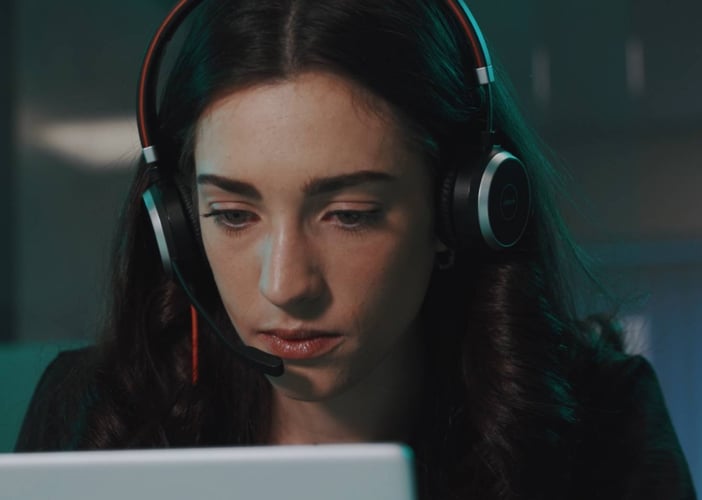
The Emergency Medical Communication Centre (AMK), known as the medical emergency telephone number 113 in Norway, is a key in the emergency medical chain in Norway. Every year, the AMK answers over one million emergency calls, a number that is constantly rising.
The operators who answer the phones are healthcare personnel with a unique specialisation as AMK operators. Through a conversation of a few minutes, they must assess the severity, initiate the appropriate response and, in some cases, guide the caller in life-saving first aid. Every second counts, and the quality of the conversation can mean the difference between life and death.
Despite the crucial role played by AMK operators, there is little research on the AMK subject. In addition, there is a lack of standardised and quality-assured education. The training varies between the centres, which makes this a field with great potential for better quality.
A simulator for the future of emergency medical communication training
To meet this need, AMK Simulator was developed. The project started in 2020 with support from the Research Council of Norway and led by RAKOS (Regional Emergency Medical Competence Centre in the Western Norway Regional Health Authority) in collaboration with AMK Stavanger, SAFER, NKLM and the technology company Sklls AS.
The goal is to give operators the opportunity for frequent and realistic training in the same way that pilots practice serious incidents in a flight simulator. The simulator calls the operators as if it were a real distress call. AI-generated callers can simulate everything from cardiac arrest to domestic violence, and they also react emotionally like people in crisis.
From prototypes to artificial intelligence
Since its inception in June 2020, the development has taken place step by step:
- Reference group: Four AMKs in the Western Norway Regional Health Authority contributed with input and testing.
- Scripted simulator: Used in courses in Stavanger and Bergen in 2021.
- Integration: The simulator was connected to AMKs Integrated Communication and Control System (ICCS), so that training calls can be pushed out as normal emergency calls, but marked as exercise.
- Audio Logs and Speech-to-Text: As of 2021, the project has had access to real audio logs. This has made it possible to further develop AI, train one's own voices and make the simulations more realistic.
- Validation: Researchers will now investigate how simulator training affects performance and patient safety. To answer this, they will conduct future observational studies, where they follow participants over time.
From lifesaving to integration and language training for refugees
Technology has also found completely new uses. In Gjesdal municipality, refugees have been able to use the simulator to train in the Norwegian language. The AI adapts to the level of each individual and provides safe practice in everything from small talk to job interviews. Now, the developers are planning new tools based on the same technology.
"It's simply touching to see the effect. When people who are new to Norway suddenly dare to talk, participate and apply for a job, then we know that we are creating value far beyond what we thought when we started," says Trine Bjørnsen, CEO of Sklls.
Distribution in Norway and international growth
Today, almost 70 per cent of Norway's AMKs use the simulator. Several emergency clinics and emergency response organizations have also used it.
The need for emergency operator training is global. Around 40 percent of Sklls' customers are outside Norway in countries such as the USA, the UK, Austria and Denmark. The UK is a particularly important growth market. Here, the London Fire Brigade is already a customer and five ambulance services, including the London Ambulance Service, are now in the procurement process.
In the US, the simulator is used by both emergency services and private actors, such as Chemtrec, MedAire (International SOS) and Bristol Myers Squibb. In addition, Sklls partners with NECI 911 and the 911 Training Institute to strengthen the training of American 911 operators.
"AMK Simulator shows that a Norwegian product can set the standard internationally. For us at RAKOS, it is inspiring to see how our development is getting attention far beyond Norway. This is now helping to strengthen both patient safety and emergency preparedness in many countries," says Thomas W. Lindner, head of RAKOS.
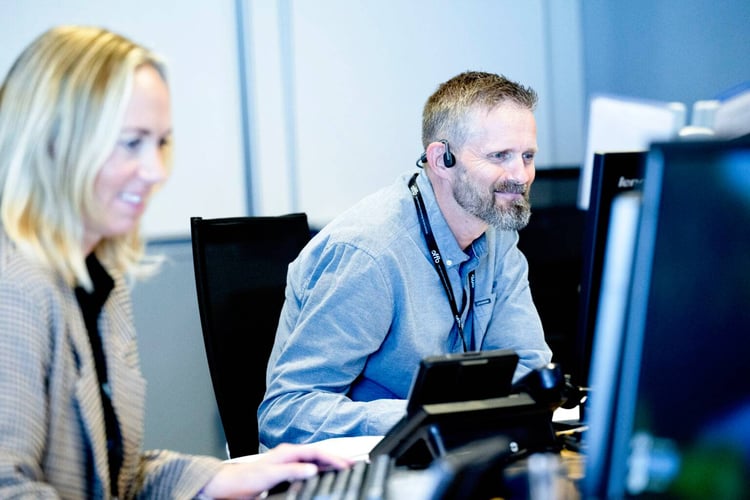
Better preparedness, strengthened patient safety and new opportunities
The Research Council's support has been crucial in developing the project and establishing collaboration across academic communities.
Today, research contributes to
- improve the training of AMK operators and strengthen emergency preparedness
- develop new methods of language learning and integration
- create international value creation and export opportunities
What started as a project on better training for AMK operators has developed into solutions that save lives, it helps to strengthen integration and it puts Norway on the map as an innovation nation in AI and simulator training.
"As a team member of RAKOS, I have experienced how valuable the collaboration between professionals, technologists and users is. The simulator gives us a concrete tool that both improves the training of operators and creates new opportunities for learning and integrating improvement tools," says Jorunn Vik, project employee at RAKOS.
Facts about the AMK Simulator
- AMK Simulator: A complete tool for competence building for medical emergency notification services, based on simulation training and artificial intelligence (2020–2025).
- Funding: The Research Council of Norway, Innovation Norway, the Western Norway Regional Health Authority and others.
- Partners in Norway: RAKOS, AMK Stavanger, SAFER, NKLM, Sklls AS, several AMKs.
- International partners/customers: NECI 911 (USA), 911 Training Institute (USA), London Fire Brigade (UK), Chemtrec (USA), MedAire/International SOS (USA), Bristol Myers Squibb (USA).
- Societal benefits: Better emergency medical response, strengthened patient safety, new tools for integration and language training.
- Read more about the project: AMK SIMULATOR: Dispatch simulator: A universal tool for training and competence improvement in the dispatch centre with help of artificial intelligence (Prosjektbanken).